RTD FasTracks HomeRTD FasTracks Connecting Communities
    
Find RTD FasTracks on Facebook Follow RTD FasTracks on Twitter RTD FasTracks on YouTube
RTD FasTracks News
Printable Version Printable Version

FAQs

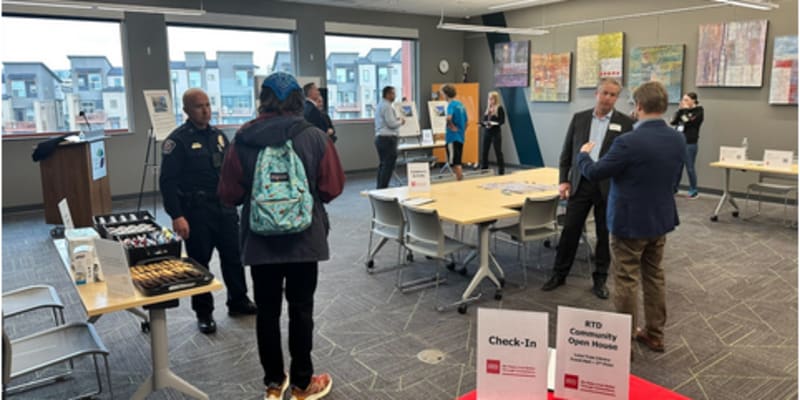
Q: What is the FasTracks Program? North Metro team member gathers comments at November public meeting
A: The Regional Transportation District (RTD)'s voter-approved FasTracks program passed in 2004. RTD FasTracks transit expansion program will build 122 miles of commuter rail and light rail, 18 miles of bus rapid transit service, add 21,000 new parking spaces, redevelop Denver Union Station and redirect bus service to better connect the eight-county District.

Q: How will FasTracks serve the North Metro Region?
A: The North Metro Rail Line includes 18.4 miles of commuter rail with eight stations.

Q: What is the proposed route?
A: The North Metro Rail Line will begin at Denver Union Station, making its first stop at the National Western Stock Show. The Line continues on through Commerce City with a stop at 72nd Avenue. From there it moves into Thornton, with stations at 88th and 104th, then through Northglenn with a station at 112th. The Line goes back into Thornton for the 124th Avenue Station, a station at 144th, before ending at SH7/162nd Avenue.

Q: What's the latest with the North Metro project and what comes next?
A: On March 15, 2012, the North Metro Team issued a Request for Proposals for final design of the first segment from Denver Union Station to National Western Stock Show Station, with an option for final design to 72nd. Those proposals are due April 19th. An anticipated Notice to Proceed is scheduled for the third quarter of 2012. Meanwhile, negotiations continue with Denver and CDOT toward reaching consensus on an Intergovernmental Agreement in the next few months.

Q. How can the public participate?
The North Metro Team welcomes public participation throughout the project. One way is to submit your comments on our website. You can also sign up for our mailing list so that you can stay informed on the progress of the project and receive periodic updates and news about recent developments and meetings.

Q. How will the project protect the safety of children and residents along the corridor?
A. Safety for children, riders and residents is a priority for all of the FasTracks rail lines. In addition to fencing and gates, which are used to keep the public safe, the North Metro Rail Line team is working closely with school districts along the corridor and will also coordinate with the various police departments and the Adams County Sheriff's department, through which the North Metro Rail Line passes, to develop any necessary safety and crime prevention programs. National studies indicate that the extension of a public transportation service does not create additional crime or increase safety problems. RTD's experience with its light rail projects has shown no increase in crime or any increase in problems for nearby schools.

Q. How will the North Metro project impact the value of homes that directly border the various alignments?
A. We understand that residents along the North Metro Rail Line tracks are concerned that the impacts of the line will negatively affect their property values. Property values are determined using many factors -- some can be related to proximity to transit but many are not. Several factors are very subjective and make determining future values very difficult. In addition, the real estate market fluctuates regularly, so individual property values will fluctuate as well. There are, however, recent studies conducted around the country that concluded property values tend to increase near transit stations providing connectivity to a regional transportation system.

Q. How will commuter rail noise and vibration be addressed?
A. As part of the planning phase for each of the FasTracks rail Lines, RTD addresses environmental impacts and makes recommendations for minimizing these impacts. Recognizing the effects of train horns on nearby communities, RTD will assist and facilitate the local jurisdictions' efforts to establish Quiet Zones along the Gold Line, Northwest Rail, East and North Metro Rail Lines. What is a Quiet Zone? For safety reasons, the Federal Railroad Administration currently requires trains that travel along freight tracks to sound their horns anytime the train approaches a railroad crossing - an intersection where the railroad tracks cross a roadway. Quiet Zones are railroad line segments at least a half-mile long where railroad engineers don't have to sound their train horns at railroad crossings because other safety measures have been incorporated. In addition to Quiet Zones, Sound Barrier Walls or Berms will be used for mitigation where needed. What is a Sound Barrier Wall? A sound barrier wall or Berm is constructed to deflect the train noise away from a sensitive receptor (building, park, etc) to reduce the decibel levels of unwanted noise, thus mitigating the severity of noise impacts.

Q. Will buses continue to run once FasTracks commuter rail service is open?
A. Yes. Express bus service on I-25 will remain similar to current services. Existing routes closer to the commuter rail alignment will be modified to eliminate duplication of transit service patterns and to provide feeder bus service to and from the commuter rail stations. In addition, the FasTracks program also includes new FastConnects bus service, an improvement of bus service for suburb-to-suburb travel patterns.

More Questions?
Online: www.rtd-fastracks.com
Email: NM@rtd-fastracks.com
Phone: (303) 299-2000 (follow the prompts)
Contact: Michelle Brier 303-299-6908


© 2013 FasTracks Regional Transportation District of Denver (RTD) Denver, Colorado
RTD FasTracksRTD Home Page
RTD FasTracks